
You load up your cart, check out, and wince at the total. Sound familiar? One of the simplest habits that can chip away at your grocery bill costs nothing to learn: reading the unit price label on the shelf. Most shoppers glance at the big number on the tag and move on. The ones who actually save money look a little lower.
What Is a Unit Price?
The unit price tells you how much something costs per standard unit of measurement, such as per ounce, per pound, per 100 grams, per liter, or per count. It levels the playing field so you can compare two products even when they come in wildly different package sizes.
Most grocery stores are required by law to display unit prices on shelf tags, usually in smaller print beneath the total price. It often looks something like this:
$3.49
$0.22 / oz
That bottom line is where your money is hiding.
Why the Big Price Tag Can Fool You
Here is the trap: bigger packaging does not always mean a better deal. And a lower sticker price does not mean you are spending less per unit.
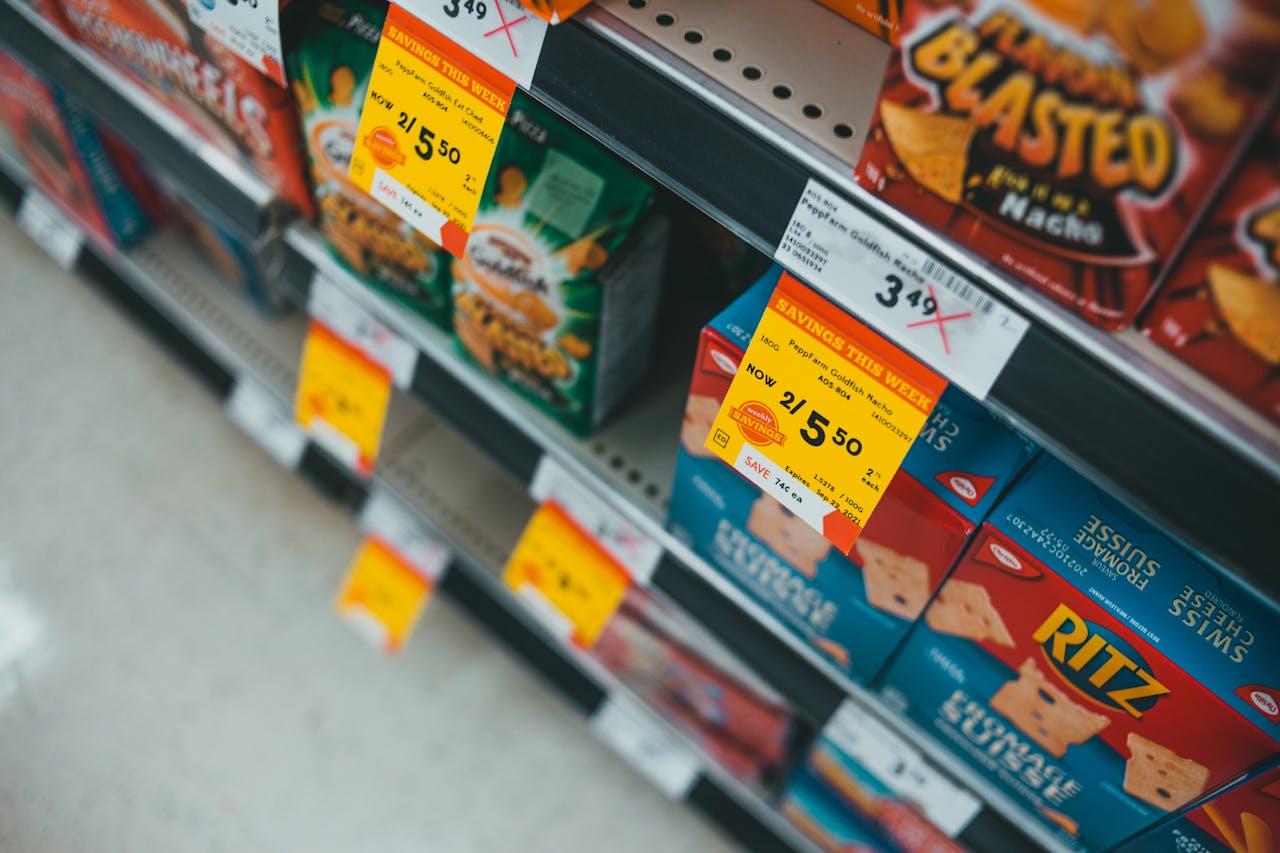
Typical grocery store shelf tag — unit price in bottom-left corner
Example 1: Peanut Butter
- Jar A: 16 oz for $2.99 — that is $0.19 per oz
- Jar B: 40 oz for $6.49 — that is $0.16 per oz
Jar A looks cheaper at the register. But if you eat peanut butter regularly, Jar B saves you about 3 cents per ounce. Buy a jar a month and that adds up to roughly $7 saved over a year on one item alone.
Example 2: Canned Tomatoes
- Store brand, 14.5 oz can: $0.89 — $0.06 per oz
- Name brand, 28 oz can: $2.19 — $0.08 per oz
Here the smaller, cheaper-looking can actually wins on unit price. The name brand charges a premium per ounce even in the larger size.
This is exactly why you cannot trust your gut on grocery pricing. The math has to do the talking.
How to Read the Shelf Tag
Shelf tags vary slightly by store, but they generally follow a similar layout. Here is what to look for:
- Item name and brand — top of the tag
- Total price — large and prominent
- Unit price — smaller, often in the bottom-left corner
- Unit of measurement — what the price is calculated by (oz, lb, count, 100g, etc.)
Some stores print the unit price in a small box separate from the main price area. Others print it in a different color. If you cannot find it, look for the fine print near the barcode strip on the shelf edge.
Watch Out for Mismatched Units
Here is where it gets tricky: not every product on the same shelf will use the same unit of measurement. This is either an oversight or, cynically, a feature that makes comparison harder.
Example 3: Olive Oil
- Brand X: listed as $0.49 per fl oz
- Brand Y: listed as $52.00 per liter
To compare these, you need to convert. There are about 33.8 fluid ounces in a liter, so Brand Y works out to roughly $1.54 per fl oz. Brand X is the clear winner, but you would never know that without doing the conversion.
A few conversions worth memorizing:
- 1 liter = 33.8 fl oz
- 1 pound = 16 oz
- 1 kilogram = 35.3 oz
Or just pull out your phone. Comparing unit prices across different measurement systems takes about ten seconds with a calculator.
When Bigger Is Not Better
Buying in bulk is smart when you will actually use the product before it expires and when you have the storage space. But bulk is not always the deal it appears to be.
Example 4: Greek Yogurt
- Single-serve 5.3 oz cup: $1.29 — $0.24 per oz
- 32 oz tub: $5.49 — $0.17 per oz
The tub wins on unit price. But if you only eat yogurt occasionally and toss half of it, you have not saved anything. You have spent more.
The unit price only helps you if the product gets used.
The Store Brand Question
Store brands (also called generic or private label products) almost always have a lower unit price than name brands. The quality gap has narrowed considerably over the years, and for many staple items like flour, sugar, canned vegetables, pasta, and spices, store brands are essentially identical to name brands in composition.
Example 5: Shredded Mozzarella
- Name brand, 8 oz bag: $3.79 — $0.47 per oz
- Store brand, 16 oz bag: $4.49 — $0.28 per oz
The store brand is twice the size for barely more money, coming in at 40% less per ounce. That is a significant difference on a product most households go through regularly.
Sale Prices and Unit Prices Together
Sales can skew things in interesting ways. A name brand on sale might actually undercut the store brand’s regular unit price, which is worth catching.
Example 6: Pasta Sauce
- Store brand, 24 oz jar: $1.99 — $0.08 per oz (regular price)
- Name brand, 24 oz jar: $3.49 — $0.15 per oz (regular price)
- Name brand on sale, 24 oz jar: $1.79 — $0.07 per oz
During the sale, the name brand beats the store brand. If you like it better, stock up. The unit price tells you exactly when that opportunity is worth taking.
A Simple Habit That Pays Off
You do not need to become a spreadsheet person or spend an extra hour at the grocery store. Here is a practical approach:
- For products you buy every single week (milk, eggs, bread, protein, cooking oil), take thirty seconds to compare unit prices across sizes and brands once. Then make it your default.
- For products you buy occasionally, check the unit price before grabbing the most familiar option. The answer might surprise you.
- When something is on sale, use the unit price to decide whether it is actually a deal or just loud signage.
The goal is not perfection. Even catching two or three better unit prices per shopping trip can save $10 to $20 a month for a typical household — $120 to $240 a year from a habit that costs nothing but a few seconds of attention.


